Nov 30, 2008

Welcome to kidz!

Welcome! This is a site that celebrates the lives and lessons of special needs children, a.k.a. kidz. This is a site for everyone, not just friends and families of kidz. Our mission is to increase awareness and understanding about different health conditions and to help all people cope with challenges and enjoy life!

Most of our posts will be inspired by our readers, so it is important that everyone participates! Please leave comments galore!

Here's how it works:
  1. Meet the kidz behind kidz. They are our inspiration. A new story will be posted at least once a week. To find their stories, click here.
  2. Follow us and let people know you support kidz. Add yourself to our list of followers on the left sidebar. Add us to your blog list. Then let others know you're a kidz supporter by adding this button to your sidebar.


    Just copy & paste the following code into your blog or website (be sure to scroll all the way down to get the whole code


  3. Check in often and participate! We LOVE comments. Leaving a comment on what you learned from the spotlighted child, or by sharing ideas or resources you have is the best way to show support! Feel free to leave the link to a post you'd like to share, either on a comment or by emailing us (email address below). Your post can be about anything that is inspiring: a funny story, an uplifting thought, a beautiful photo, a special memory, a fun activity idea, a cute craft, etc.
  4. Email us. If you have a story, a resource, an idea, or a thought you would like to be featured, email kidzorg.blogspot@gmail.com. We love emails almost as much as comments, so please - send an email! We like to feature those who support kidz often, so be sure to leave comments.
  5. Subscribe. Enter your email address under the Subscribe title on the lower right sidebar. Once you do this, you will be notified every time there is a new post. This is a great way to keep up-to-date. Every time you get an email you will be reminded it's time to get inspired and leave a comment to inspire others!
  6. Meet the Kidz Krew. The 'Kidz Krew' is a group of mothers who have special needs children and do frequent posts on this blog. You can meet them by checking out their photos on the right sidebar. Just click on their photo(s) and you will be taken to their personal blogs to 'meet' them! They are all incredible people and it's worth your time to get to know them.

Okay, now you're all set. Click here to get started!

Nov 25, 2008

Talk to Me Tuesday

It's Talk to Me Tuesday again! Now, now, don't everyone jump on the Mr Linky at once! ;o) No, really, there were only two participants last week. I know it's a holiday week, so I won't make my expectations too high, but please think of something fabulous you've learned or experienced or felt recently. Post it on your blog. Then add your link here. It's that easy! It will definitely make my day and it might make someone else's too.

Nov 24, 2008

Picture Wreath

I always like to give my parents and my husband's parents a little gift on Thanksgiving Day to kick off the Christmas season - a Christmas cd, a candle, an ornament, a decoration, etc.... This year I decided to create a gift that is not only festive, but also a keepsake!.... A picture wreath.


Here's how I did it....

1. Gathered some of my favorite photos of Chloe.

2. Narrowed it down to 9.

3. Used a dye-cutting machine to cut nine 4" circles with a decorative edge and an inner circle.

4. Cut the photos into 3 3/4" circles.

5. Attached the photos behind the circles.

6. Attached the circles to each other into one large circle.

7. Attached a ribbon to the top and smaller ribbons randomly on the wreath.

8. Admired my creation and took photos!


This is an easy and cheap gift. And grandparents will LOVE it!!!

Nov 23, 2008

Give Thanks in All Circumstances

"Rejoice always, pray without ceasing, give thanks in all circumstances; for this is the will of God in Christ Jesus for you." --1Ths. 5:18

I wanted to share that scripture and the following excerpt from The Hiding Place by Corrie Ten Boom, which is a story of two sisters surviving a Nazi concentration camp. One of my favorite life lessons is to give thanks in all things, and this excerpt from this book solidified that concept for me and forever changed my perspective and reaction to so-called hardships.

"Barracks 8 was in the quarantine compound. Next to us--perhaps as a deliberate warning to newcomers--were located the punishment barracks. From there, all day long and often into the night, came the sounds of hell itself. They were not the sounds of anger, or of any human emotion, but of a cruelty altogether detached: blows landing in regular rhythm, screams keeping pace. We would stand in our ten-deep ranks with our hands trembling at our sides, longing to jam them against our ears, to make the sounds stop.

"It grew harder and harder. Even within these four walls there was too much misery, too much seemingly pointless suffering. Every day something else failed to make sense, something else grew too heavy.

"But as the rest of the world grew stranger, one thing became increasingly clear. And that was the reason the two of us were here. Why others should suffer we were not shown. As for us, from morning until lights-out, whenever we were not in ranks for roll call, our Bible was the center of an ever-widening circle of health and hope.

"Like waifs clustered around a blazing fire, we gathered about it, holding out our hearts to its warmth and light. The blacker the night around us grew, the brighter and truer and more beautiful burned the Word of God.

"Who shall separate us from the love of Christ? Shall tribulation, or distress, or persecution, or famine, or nakedness, or peril, or sword?...Nay, in all these things we are more than conquerors through him that loved us."

"I would look about us as Betsie read, watching the light leap from face to face. More than conquerors...It was not a wish. It was a fact.

"We knew it, we experienced it minute by minute--poor, hated, hungry. We are more than conquerors. Not "we shall be." We are!

"Life in Ravensbruck took place on two separate levels, mutually impossible. One, the observable, external life, grew every day more horrible. The other, the life we lived with God, grew daily better, truth upon truth, glory upon glory.

"Sometimes I would slip the Bible from its little (sack) with hands that shook, so mysterious had it become to me. It was new; it had just been written. I marveled sometimes that the ink was dry...I had read a thousand times the story of Jesus' arrest--how soldiers had slapped Him, laughed at Him, flogged Him. Now such happenings had faces and voices.

"Fridays--the recurrent humiliation of medical inspection. The hospital corridor in which we waited was unheated and a fall chill had settled into the walls. Still we were forbidden even to wrap ourselves in our own arms, but had to maintain our erect, hands-at-sides position as we filed slowly past a phalanx of grinning guards.

"How there could have been any pleasure in the sight of these stick-thin legs and hunger-bloated stomachs I could not imagine. Surely there is no more wretched sight than the human body unloved and uncared for.

"Nor could I see the necessity for the complete undressing: when we finally reached the examining room a doctor looked down each throat, another--a dentist presumably--at our teeth, a third in between each finger. And that was all. We trooped again down the long, cold corridor and picked up our X-marked dresses at the door.

"But it was one of these mornings while we were waiting, shivering in the corridor, that yet another page in the Bible leapt into life for me.

"He hung naked on the cross.

"...The paintings, the carved crucifixes showed at least a scrap of cloth. But this, I suddenly knew, was the respect and reverence of the artist. But oh--at the time itself, on that other Friday morning--there had been no reverence. No more than I saw in the faces around us now.

"'Betsie, they took His clothes too.'

"'Ahead of me I heard a little gasp. 'Oh, Corrie. And I never thanked Him...'

"Every day the sun rose a little later, the bite took longer to leave the air. It will be better, everyone assured everyone else, when we move into permanent barracks. We'll have a blanket apiece. A bed of our own. Each of us painted into the picture her own greatest need.

"The move to permanent quarters came the second week in October. We were marched, ten abreast, along the wide cinder avenue...Several times the column halted while numbers were read out--names were never used at Ravensbruck. At last Betsie's and mine were called...We stepped out of line with a dozen or so others and stared at the long gray front of Barracks 28.

"Betsie and I followed a prisoner-guide through the door at the right. Because of the broken windows, the vast room was in semi-twilight. Our noses told us, first, that the place was filthy: somewhere, plumbing had backed up, the bedding was soiled and rancid.

"Then as our eyes adjusted to the gloom we saw that there were no individual beds at all, but great square tiers stacked three high, and wedged side by side and end to end with only an occasional narrow aisle slicing through.

"We followed our guide single file--the aisle was not wide enough for two--fighting back the claustrophobia of these platforms rising everywhere above us...At last she pointed to a second tier in the center of a large block.

"To reach it, we had to stand on the bottom level, haul ourselves up, and then crawl across three other straw-covered platforms to reach the one that we would share with--how many?

"The deck above us was too close to let us sit up. We lay back, struggling against the nausea that swept over us from the reeking straw...Suddenly I sat up, striking my head on the cross-slats above. Something had pinched my leg.

"'Fleas!' I cried. 'Betsie, the place is swarming with them!'

"We scrambled across the intervening platforms, heads low to avoid another bump, dropped down to the aisle and hedged our way to a patch of light.

"'Here! And here another one!' I wailed. 'Betsie, how can we live in such a place!'

"'Show us. Show us how.' It was said so matter of factly it took me a second to realize she was praying. More and more the distinction between prayer and the rest of life seemed to be vanishing for Betsie.

"'Corrie!' she said excitedly. 'He's given us the answer! Before we asked, as He always does! In the Bible this morning. Where was it? Read that part again!'

"I glanced down the long dim aisle to make sure no guard was in sight, then drew the Bible from its pouch. 'It was in First Thessalonians,' I said. We were on our third complete reading of the New Testament since leaving Scheveningen.

"In the feeble light I turned the pages. 'Here it is: "Comfort the frightened, help the weak, be patient with everyone. See that none of you repays evil for evil, but always seek to do good to one another and to all...'" It seemed written expressly to Ravensbruck.

"'Go on,' said Betsie. 'That wasn't all.'

"'Oh yes:'..."Rejoice always, pray constantly, give thanks in all circumstances; for this is the will of God in Christ Jesus.'"

"'That's it, Corrie! That's His answer. "Give thanks in all circumstances!" That's what we can do. We can start right now to thank God for every single thing about this new barracks!' I stared at her; then around me at the dark, foul-aired room.

"'Such as?' I said.

"'Such as being assigned here together.'

"I bit my lip. 'Oh yes, Lord Jesus!'

"'Such as what you're holding in your hands.' I looked down at the Bible.

"'Yes! Thank You, dear Lord, that there was no inspection when we entered here! Thank You for all these women, here in this room, who will meet You in these pages.'

"'Yes,' said Betsie, 'Thank You for the very crowding here. Since we're packed so close, that many more will hear!' She looked at me expectantly. 'Corrie!' she prodded.

"'Oh, all right. Thank You for the jammed, crammed, stuffed, packed suffocating crowds.'

"'Thank You,' Betsie went on serenely, 'for the fleas and for--'

"The fleas! This was too much. 'Betsie, there's no way even God can make me grateful for a flea.'

"'Give thanks in all circumstances,' she quoted. It doesn't say, 'in pleasant circumstances.' Fleas are part of this place where God has put us.

"And so we stood between tiers of bunks and gave thanks for fleas. But this time I was sure Betsie was wrong."

"They started arriving soon after 6:00 o'clock, the women of Barracks 28, tired, sweat-stained, and dirty from the long forced-labor details. The building, we learned from one of our platform mates, had been designed to hold four hundred. There were now fourteen hundred quartered here with more arriving weekly as concentration camps in Poland, France, Belgium, Austria, as well as Holland were evacuated toward the center of Germany.

"There were nine of us sharing our particular square, designed for four, and some grumbling as the others discovered they would have to make room for Betsie and me. Eight acrid and overflowing toilets served the entire room; to reach them we had to crawl not only over our own bedmates but over those on the other platforms between us and the closest aisle, always at the risk of adding too much weight to the already sagging slats and crashing down on the people beneath.

"Even when the slats held, the least movement on the upper platforms sent a shower of dust and straw over the sleepers below--followed by a volley of curses. In Barracks 8 most of us had been Dutch. Here there was not even a common language and among exhausted, ill-fed people quarrels erupted constantly.

"There was one raging now as the women sleeping nearest the windows slammed them shut against the cold. At once scores of voices demanded that they be raised again. Brawls were starting all up and down that side of the room; we heard scuffling, slaps, sobs.

"In the dark, I felt Betsie's hand clasp mine. 'Lord Jesus,' she said aloud, 'send Your peace into this room. There has been too little praying here. The very walls know it. But where You come, Lord, the spirit of strife cannot exist...'

"The change was gradual, but distinct. One by one the angry sounds let up.

"'I'll make you a deal!' The voice spoke German with a strong Scandinavian accent. 'You can sleep in here where its warmer and I'll take your place by the window!'

"'And add your lice to my own!' But there was a chuckle in the answer. 'No thanks.'

"'I'll tell you what!' The third voice had a French burr. 'We'll open them halfway. That way we'll be only half-frozen and you'll be only half-smothered.'

"A ripple of laughter widened around the room at this. I lay back on the sour straw and knew there was one more circumstance for which I could give thanks. Betsie had come to Barracks 28.

"Roll call came at 4:40 a.m. here as it had in quarantine. A whistle roused us at 4:00 when, without even shaking the straw from clothes and hair, the stampede began for the ration of bread and coffee in the center room. Lastcomers found none.

"After roll call, work crews were called out. For weeks Betsie and I were assigned to the Siemens factory. This huge complex of mills and railroad terminals was a mile and a half from the camp. The "Siemens Brigade," several thousand of us, marched out the iron gate beneath the charged wires into a world of trees and grass and horizons. The sun rose as we skirted the little lake; the gold of the late fall fields lifted our hearts.

"The work at Siemens, however, was sheer misery. Betsie and I had to push a heavy handcart to a railroad siding where we unloaded large metal plates from a boxcar and wheeled them to a receiving gate at the factory. The grueling workday lasted eleven hours. At least, at noontime we were given a boiled potato and some thin soup; those who worked inside the camp had no midday meal.

"Returning to camp we could barely lift our swollen and aching legs. The soldiers patrolling us bellowed and cursed, but we could only shuffle forward inches at a step.

"Back at the barracks we formed yet another line--would there never be an end to columns and waits?--to receive our ladle of turnip soup in the center room. Then, as quickly as we could for the press of people, Betsie and I made our way to the rear of the dormitory room where we held our worship "service." Around our own platform area there was not enough light to read the Bible, but back here a small light bulb cast a wan yellow circle on the wall, and here an ever larger group of women gathered.

"They were services like no others, these times in Barracks 28.

"At first Betsie and I called these meetings with great timidity. But as night after night went by and no guard ever came near us, we grew bolder. So many now wanted to join us that we held a second service after evening roll call. There on the Lagerstrasse we were under rigid surveillance, guards in their warm wool capes marching constantly up and down. It was the same in the center room of the barracks: half a dozen guards or camp police always present. Yet in the large dormitory room there was almost no supervision at all. We did not understand it.

"One evening I got back to the barracks late from a wood-gathering foray outside the walls. A light snow lay on the ground and it was hard to find the sticks and twigs with which a small stove was kept going in each room. Betsie was waiting for me, as always, so that we could wait through the food line together. Her eyes were twinkling.

"'You're looking extraordinarily pleased with yourself,' I told her.

"'You know, we've never understood why we had so much freedom in the big room,' she said. 'Well--I've found out.'

"That afternoon, she said, there'd been confusion in her knitting group about sock sizes and they'd asked the supervisor to come and settle it.

"But she wouldn't. She wouldn't step through the door and neither would the guards. And you know why?"

"Betsie could not keep the triumph from her voice: 'Because of the fleas! That's what she said, "That place is crawling with fleas!'"

"My mind rushed back to our first hour in this place. I remembered Betsie's bowed head, remembered her thanks to God for creatures I could see no use for."

Nov 22, 2008

Sing To Me Saturday

"Thankful"
by Josh Groban
Somedays we forget
To look around us
Somedays we can't see
The joy that surrounds us
So caught up inside ourselves
We take when we should give.
So for tonight we pray for
What we know can be.
And on this day we hope for
What we still can't see.
It's up to us to be the change
And even though we all can still do more
There's so much to be thankful for.
Look beyond ourselves
There's so much sorrow
It's way too late to say
I'll cry tomorrow
Each of us must find our truth
It's so long overdue
So for tonight we pray for
What we know can be
And every day we hope for
What we still can't see
It's up to us to be the change
And even though we all can still do more
There's so much to be thankful for.
Even with our differences
There is a place we're all connected
Each of us can find each other's light
So for tonight we pray for
What we know can be
And on this day we hope for
What we still can't see
It's up to us to be the change
And even though this world needs so much more
There's so much to be thankful for

Nov 21, 2008

Be Grateful

Thanksgiving is coming quickly. I've come to know that I readily recognize my many reasons to be thankful to God and to others, but giving and showing thanks to them comes with more difficulty. I've been thinking about this a lot during this Thanksgiving season and found some ways to express gratitude and let others know they are appreciated. Try these ideas with your children, spouses, family, friends....


  • Just say it. "Feeling gratitude and not expressing it is like wrapping a present and not giving it." --William Arthur Ward

  • Be aware of what they like. Plan activities with them that they enjoy. Does your child enjoy coloring? Don't just give them a coloring book and crayons. Sit down with them. Color your own picture. Does your spouse enjoy being in the outdoors? Plan an outing to the mountains. This shows that you are aware of them and want to create memories with them. It will make them feel appreciated and create wonderful memories for them to reminisce over.

  • Give hugs & snuggles. Hold hands. "You can't wrap love in a box, but you can wrap a person in a hug." --Unknown

  • Help them. Not just when they ask, but seek out those opportunities. I had a friend once who felt unappreciated in his marriage. He said he wished just once his wife would bring out a glass of water while he was mowing the lawn. Such a simple task would have made him feel so appreciated.

  • Leave a note. Send a text message or an email. Put a note in the car or on the mirror letting them know you appreciate all they do. Send a quick text message during the day letting them know you appreciate their hard work (at school or at work).

  • Make their favorite treats. Is there a better way to show you care for someone than making something sweet?

  • Give praise to them in front of others. My husband does this. It goes a long way. It makes me want to do more for him. I appreciate being appreciated! I want to make him feel that way too.


"Gratitude unlocks the fullness of life. It turns what we have into enough, and more. It turns denial into acceptance, chaos to order, confusion to clarity. It can turn a meal into a feast, a house into a home, a stranger into a friend. Gratitude makes sense of our past, brings peace for today, and creates a vision for tomorrow."-- Melody Beattie

Nov 20, 2008

What It Means To Be Brave

Taken from thisibelieve.org. Written by Scott from Denver, CO.


I believe in the bravery of the human spirit as expressed through my daughter, Brenna.


Let me first supply some background information. My wife, Pat, and I are the parents of developmentally disabled, 16 year old twin daughters, Brenna and Logan. Although Logan has every bit as much to offer the world, I need to talk here about Brenna.Brenna and her sister participate in a variety of sports offered through Special Olympics. But Brenna is, first and foremost, a swimmer. And not only a Special Olympics swimmer. Last summer she insisted on joining our local club’s team, even though practices started at 7:00 am every weekday. We never had to roust her out of bed, she never complained, and she always received enthusiastic support from her coaches.What is extraordinary about Brenna is that when she climbs up onto the starting block she knows she will be finishing in last place, sometimes by two pool lengths or more. What kind of courage does that take? Knowing that even if you put forth your very best effort, you will still finish last. It is this kind of courage that brings tears to my eyes every time I see her stretching into the water.


Now this past summer, Brenna was determined to learn the butterfly, that beautiful double arm stroke with the dolphin kick. She wanted to compete in the individual medley (butterfly, backstroke, breaststroke, freestyle) in the next Special Olympics season. SO now besides 90 minutes of daily practice, she was in the pool for an additional 30 minutes for the next 8 weeks. Finally, near the end of the season, she could do it without the danger of disqualification. It wasn’t pretty, but it was the butterfly.


During this last regular meet of the season Brenna pounded out her strokes, again in last place. I was so focused on her it took me awhile to realize that nearly every member of the swim team from 6 year olds to high school seniors was crowded at the edge of the pool yelling her name. Parents, whom I had never met, were urging her forward. Eventually, even swimmers and coaches from opposing teams shouted their encouragement as Brenna struggled through the last agonizing yards. A round of applause greeted Brenna as she ever so haltingly lifted herself from the pool, promptly throwing up. But she was happy and proud.


Fast forward a few months and Brenna was now a member of her high school swim team, a small but dedicated crew. Her persistence in learning the butterfly has led to a curious twist. She was now scoring points fro her team in the individual medley and butterfly. In fact, in a recent dual meet she received one first place in the individual medley as she was the only entrant, and received another first place in the butterfly because the other two swimmers were disqualified for their kick.The high school season is now over, but we have to go shopping for a jacket. In February Brenna was awarded a letter. And she can’t wait for the Special Olympics swim season to begin.


The Special Olympics oath goes “Let me win, but if I cannot win, let me be brave in the attempt.”
Brenna has taught me what it means to be brave. This I believe.


Nov 19, 2008

Matters of the Heart

by Shelly Williams Johnson of Keeping Up With the Johnsons

When we found out we were having a boy I was elated and mortified. The elation was due to the fact that we already had two beautiful little girls. Emma was two-years-old and Abby was one year. The closeness of age didn't scare me. When Abby came 13 months after Emma, I resigned myself to having children very close in age and being done bearing children by the time I was 30. No, what scared me to death was realizing that my baby was going to go under the knife for a circumcision. That scared me near to vomiting. Unfortunately, I had no idea how trivial that detail would become in my son's life.

During my pregnancy I was completing my sophomore year in college. I had been attending school for about a year after high school, but wanted more direction in my life than just taking a bunch of classes I had to pay for that may or may not contribute to my final degree. Instead, I took time off, got married to my best friend Josh, and we began having babies. Josh and I decided to go back to school not long after our second daughter, Abby, was born. We knew it would be difficult, but we also knew it was the only real option we had if we wanted to make a good life for our children. Josh was working on a biology degree and I thrived on my theatre degree. I acted in my first lead role while pregnant with Matthew. Luckily, I wasn't showing too much at that point. I made it through the spring semester without any real hiccups trying to balance home, school, and pregnancy, until right before finals week.

About three weeks left in the semester I saw my midwife for a checkup. I had been scheduled for an ultrasound because the one taken at 20 weeks didn't get a good look at Matthew's heart and kidneys. We sat through the ultrasound and joked around by asking if he were still a boy. Josh and I thought nothing of the extreme delay we experienced afterward as we waited for the midwife to give us the results of the ultrasound. We often waited in that office. My main concern that day was asking if there was any concern with the umbilical cord wrapping around him since he was such an active baby. I felt it was legitimate since Josh had been wrapped in his and my sister had been wrapped in hers. Nothing prepared me, however, for the look on our midwife's face as she entered the room.

As the world stood still, we learned that our son had a defect in his heart. His heart. The organ that allowed the rest of his body to function. The symbol of love and unity. The center of his soul. His heart had a problem and my heart broke.

Our good midwife explained to us that there was no blood pumping through his pulmonary valve, but he was okay for now because a fetus' heart contains a shunt called the patent ductus arteriosus, or PDA, which connects the pulmonary artery and the aortic arch. This allows the heart to bypass the lungs and so the pulmonary valve is not necessary at this stage in life. The PDA generally closes itself almost immediately after birth and sort of "dissolves" in a few weeks. We discovered later that this PDA would need to be kept open by medication to keep Matthew alive until his valve could be taken care of.

Our next step was to receive a phone call from the obstetrician who oversaw our midwife. He confirmed her suspicions of the situation and set us up to see a pediatric cardiologist in Denver, CO. The week before our college finals we drove the four hours to Denver to consult with him.

Josh, my mother, and I met the pediatric cardiologist and thus began my education of the anatomy of the heart. We looked at pictures, models, and even an echo cardiogram of Matthew's heart to determine the severity of his condition. We learned the term "Pulmonary Artesia." Matthew's pulmonary valve was there but completely blocked. Unfortunately, a fetal echo cardiogram can't be 100% accurate, so we still didn't know the true extent of the complications associated with this condition except that the word "surgery" came up. The doctor hoped to be able to wait a few days after his birth to perform surgery, but he wouldn't know for sure until Matthew made his debut in the world. Suddenly that circumcision didn't seem so bad after all.

I lost a bit of my luster of life at that point. I was suddenly very afraid of my baby being born. While he was inside my belly he was safe. His constant movement reminded me that he was "alive and kicking." I couldn't be so sure of his well-being after he came out. I performed my duties as a student to the best of my ability, but I'm sure I had some extra leniency from my professors who knew all too well my circumstances. I took care of my beautiful girls the best I could, wondering if I'd have to explain to toddlers what death was. And Josh and I held each other at every chance we could. Neither of us wanted to face the possibility of the sadness that could be ours, so we immersed ourselves in each other. We prayed a lot. We called on the power of God to grant us the blessings of peace and comfort. We often felt that our son would be big, strong, and healthy, but the worry never completely dissipated.

I was given the name of a woman in our area whose daughter had also had pulmonary artesia. I called and talked to her about her experience. Her daughter was now graduating from college and about to accept a position with The American Heart Association. The woman and I bonded over the worry we both felt for our children, despite the fact that our children were so far apart in age. She warned me that there would be a lot of tubes and wires surrounding Matthew after birth. She warned me that there would be tough times ahead and to keep close to my Heavenly Father. She warned me that there may be limitations placed upon my son. She also expressed love, concern, empathy, and a desire to keep us in her prayers. I never spoke to her again, but I was so glad to know that there really was someone out there, even someone in our tiny community, who knew what we were going through. Just having that knowledge lifted a little bit of our burden.

Because we lived so far from Denver, I was scheduled to be induced into labor a week before Matthew's due date. June 28, 2004, we met many of our family members at Chuck E. Cheese's in Colorado Springs to have dinner together in anticipation of my being admitted to the hospital at 8pm that evening. We happily let the girls play and rejoiced in my sister's announcement that she and her husband would be expecting their second child in 7 1/2 months. We tried to enjoy the time with our girls and the rest of our family and avoid the reality that was about to hit us in the faces: what was going to happen to our son? We arrived at the hospital and the induction began.

By the next morning, my labor was progressing, but it was much more painful than I remembered it being with the girls. I had no medication with either girl, since needles scare me. The one time I went to donate blood I was turned away because I got lightheaded and sick before any needle punctured my skin. But never the one to portray weakness, I gave birth very naturally and expected to do the same with Matthew. It didn't take long for my facade to fade and I asked for the epidural. Something wasn't right--it hurt too much. When I was eventually rushed down the hallway for an emergency c-section, more fears came to pass. Now I was going under the knife. It just couldn't be easy for us, could it?

As I had originally feared, the umbilical cord was wrapped around Matthew, suffocating him. The doctor pulled his limp body out of my belly and told the neonatal team to "Jump start this baby." Luckily, they were there waiting for us anyway because of Matthew's heart. Between the cord and Matthew's heart, I wondered if my baby had any chance of survival. Finally I got to see him for a few brief seconds before the team rushed him to the Neonatal Intensive Care Unit (NICU) to continue to check his heart. Josh felt torn between the two of us: did he stay with his wife who just underwent emergency childbirth, or did he follow his son to find out his condition. Of course I told him to go with Matthew. I was just going to be stitched up, or so I thought. Unfortunately, with the cord wrapped so tightly around Matthew, I experienced some tearing and bleeding and ended up needing a blood transfusion. It took a long time for me to get into the recovery room and even longer for me to be healthy enough to try at getting into the NICU to see Matthew up close.

When I finally made it into the NICU, I followed my friend's advice and prepared myself for the tubes and wires. There were many. I don't even know what they all were for. But it was impossible for me to hold him. I ran my finger along his cheek and spoke to him for the first time. I was asked by the nurse to stop touching him because I was exciting him too much and causing his heartbeat to rise. I forced back the tears that stung my eyes and selfishly touched him when she wasn't looking. He was my baby and I was going to provide him some sort of comfort in this new world that couldn't be comfortable for him to be thrown into. It wasn't too long before I was able to nurse him and even walk to the NICU by myself to see him. I hated the thought that he was alone, although I knew he was sleeping most of the time. I eventually got used to the idea that I didn't have to guard him 24/7 and that I should follow the old adage of Mommy sleeps when Baby sleeps.


I think it's important to warn any parent whose baby is covered in wires and tubes about the placement of IVs. I had no idea that the best place to stick a newborn for an IV was in the head. The nurses had forgotten to call me to warn me before I came in that Matthew's head would be bandaged and a huge needle-like thing would be sticking out of it. They also forgot to warn me when the second IV was placed on the other side of his head. My mother convinced me that I should take a picture of it, but I was so devastated by the whole thing that I refused to take the picture with my camera, so she took it on hers for me.

What surprised me the most about the NICU was the guilt I experienced when I saw my baby laying next to the other babies in the unit. Sometimes I felt that we didn't belong in there. Matthew grew so well in-utero that he was born 8 lbs 4 oz. He was the size of the three month old boy about to be transferred up to the Pediatric Intensive Care Unit (PICU). He looked so healthy. His feet were a bit purple, but other than that, he looked like a typical newborn. In fact, the nurses almost seemed to complain about him because when he woke up hungry, he cried. But he cried the typical newborn cry, not the mewing of a preemie. He just seemed too healthy to be there, and I felt like we were wasting the doctors' and nurses' time and energy. I had to remind myself that Matthew was known as a "cardiac baby" and he needed to be there just as much as any other baby in the unit. He still needed constant medical attention.

Shortly after birth, Matthew had his first echo cardiogram outside of the womb. The cardiologist discovered that Matthew's valve had formed almost completely. The leaflets of the valve had even formed, but they were completely sealed shut. One of our options was surgery to open the leaflets manually. Another cardiologist in the practice asked if we'd consider allowing him to perform a "procedure" rather than a "surgery." This procedure was called a Balloon Catheter Procedure and would be much less invasive. The doctor would enter one of Matthew's veins in his groin area and thread a catheter up into Matthew's heart where it would follow the flow of blood to the pulmonary valve. Once there, a special procedure would cauterize a small hole which would allow the placement of a balloon. The balloon would then expand and essentially burst open the valve to allow blood flow. I was a little skeptical of how well this would work. I worried that it would cause more damage than cure, but I knew that it may delay surgery which was the alternative if this didn't work anyway. We had to wait about four days for the proper equipment for the cauterization to come down from Toronto, Canada, along with the doctor authorized to use it. In the meantime, we watched Matthew's vitals, especially his oxygen levels. A healthy person's oxygen levels are generally between 98 - 100%, meaning they are utilizing their oxygen to the fullest extent possible. Matthew's doctor was happy to see him at 70%. However, Matthew had to have an oxygen tent (which he threw on the floor when he was three days old) and then a nasal cannula to keep him above 70%. About two weeks after birth, Matthew had his second balloon-cath (minus the fancy Canadian equipment and doctor) and his oxygen improved enough for us to take him home.


We watched Matthew grow and he seemed to have sufficient energy. He was such a laid-back baby, that we didn't realize he wasn't reaching his full potential as far as his energy level was concerned. The following December he had his third balloon-cath procedure, and then a fourth one July 2005. Because the blood had backed up so much in his heart before he was born, his muscles in his right ventricle overdeveloped and decreased the amount of space within the ventricle for blood flow. His tricuspid valve had also experienced too much strain during this time and also decreased its functionality. After the four balloon-caths, we realized that Matthew's heart wasn't repairing itself like we had hoped. The annulus which holds the pulmonary valve in place was the size it should have been when Matthew was born, not a year old. The balloon-caths kept his heart working, but didn't solve the problem. We were told that we needed to decide if we should try the balloon-cath again or just opt for surgery. Josh and I both knew that another balloon-cath was just delaying the inevitable. Our cardiologist had never needed to perform more than three balloons on a patient. It was time to face our fears.

October 12, 2005, Matthew endured his first heart surgery. The goal was to cut the annulus and place a patch to open the area for the valve so it could grow to the proper size. We expected this to be a one-time deal, however guilt never rid our lives completely. I watched Matthew lay in his hospital bed and cried knowing that I had opted for this to happen to him. It was because I gave permission that Matthew was in pain. Of course, the alternative was poor health ultimately ending in death, but it's hard to be rational when your child is hurting. Matthew seemed to recover without any problem, although Josh and I were still in school at this time. I didn't realize the commitment it would take for me to put off school, something I was very dedicated to, in order to make the several trips back to Denver when Matthew experienced too much fluid build-up around his heart. He was placed on Baby Aspirin, which didn't help, and then taken into the Cath lab once again to manually drain the fluid. When he finally recovered from the fluid build-up, he recovered very well. His energy increased and he lost the purple coloring in his feet. We expected him to be done with surgeries and that he'd just need to keep up on his check-ups as a precaution.
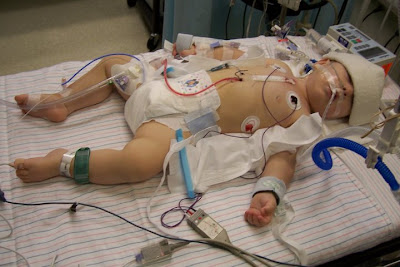


We were shocked to discover the following August that Matthew was not done with his heart surgeries. We had placed such high expectations on the first surgery that the prospect of a second knocked the wind out of us. The second surgery, with its surprise need was even more difficult to prepare for mentally and emotionally. However, Josh and I were becoming braver about expressing our worries and fears. We had no intention of staying in the little valley we lived in and one concern became, "If our son dies, do we bury him here and move him when we finally settle down, or do we just bury him in the area we expect to eventually settle down?" We'd never spoken aloud these types of worries and I don't know if it helped us prepare for the second surgery or if it made it more difficult to endure. The problem with the first surgery was that it was too aggressive. The leaflets of Matthew's valve now free-flowed and too much blood moved back and forth rather than pumping into the lungs. He needed a valve replacement, which meant more surgeries throughout our son's life as either he outgrew the valves or they collected too much calcium and needed replacement. Now our son was sentenced to a life of constant cardiac care. His zipper scar on his chest would be reopened every ten to fifteen years, if not sooner. This was going to require a lot more worry and prayers on my part. I wasn't sure I was up for this task.

Luckily, I had graduated from college by this time, so it was easier for me to get away for follow-up appointments. Josh and I came to Denver for the second surgery and we actually felt more comfortable in the hospital the second time around. Matt, however, slipped into a bit of a depression. It was March 2007, and Matthew lost his appetite and I couldn't get him to drink anything. We spent a few extra days in the hospital while Matthew regained some of his light back in his eyes. I was upset at seeing my two-year-old son slip into the melancholy he was in. I wondered if my depression had possibly caused his. Life wasn't supposed to be like this. I wasn't supposed to wonder about my baby's mortality. I wasn't supposed to watch three drainage tubes eject from his chest. I wasn't supposed to wander from hotel room to hospital room day and night. This wasn't supposed to happen to us. I had to quickly overcome my human emotions and portray my "strong maternal" emotions to help Matthew overcome his complacency with his situation. He had to get up and walk around. He had to eat and drink. He had to have the will to go on with life. We coaxed, we begged, we used reverse psychology, but mostly we kept ourselves in check and after five days in the hospital, Matthew came home.

Matthew still has his zipper scar and he has four belly-button sized scars from his drainage tubes along his chest. He has some small scars under his ear where his central line was placed for medication and such. But other than that, Matthew looks like your typical four-year-old boy. His last several check-ups have proven him to have a clean bill of health. We expect him to need his next surgery in about five years when his heart has outgrown his current valve, which is a bovine (cow) valve. As far as we know, Matthew will have no limitations as far as sports or other activities are concerned. He doesn't require any medication. We have tested him to find out if he may have a chromosomal defect known as 22 q11 deletion, but the test results came back normal. As far as we can tell, Matthew's heart condition is a fluke, an anomaly that will not effect his children or any of our other children. I did nothing while pregnant to cause his condition. It's taken me a long time to truly believe that. I think I've mentioned that I'm easily guilted.


I don't know that anything "inspiring" occurred with all of this except that we've made it this far. Sometimes just getting through the day is inspiring enough. Matthew loves his sisters and they love him. He knows what surgery is and that he has a special heart like Iron-Man. He's gained an empathy for children who are sick. He's a picky eater and defiantly tells me NO! just like any other preschooler. Josh and I made it through school. He's now an Emergency Room nurse and wants to focus on pediatrics once the opportunity is available. Despite the time I dedicated to my son during his times of health concern, I graduated Magna Cum Laude with my Bachelor's Degree. We lived day by day. We prayed, we were tremendously supported by our family and friends. Many people from church blessed our lives. We discovered that we are stronger people than we ever knew and our bonds as a family strengthened. I don't look forward to the future surgeries, but I know we'll make it. It's not possible for us to fail and lose faith. We've come too far as it is.


Nov 18, 2008

Talk To Me

Okay, everyone, KIDZ is getting closer and closer to taking flight! We're working on our professional layout, and before you know it, this will be your favorite blog! One of the aspects that will make this blog so uplifting is your participation. Once a week, I would like the readers to share an uplifting and/or inspirational post from their personal blogs. This will give the readers an opportunity to get to know each other and find what we're all looking for - a little piece of joy! If you've already done a post that is inspiring, share that one. If you haven't, think of a quote, a story, a special moment you had with a friend or your child.... just anything. Your post doesn't have to do with special needs children, it just needs to be uplifting or inspiring in some way. Then post it, and add your link! I think this will be very uplifting for all of us. Thanks for participating!

Nov 17, 2008

Creating Personal Memoirs

"Generations pass like leaves fall from our family tree. Each season new life blossoms and grows benefiting from the strength and experience of those who went before." --Heidi Swapp


It's been some time ago that my grandmother passed away. Her husband, my grandfather, is still alive, but I recorded and printed his history about three years ago. I have recently re-read their histories and gained insight into how to handle certain things that are going on in my life. I have also recorded my husband's grandfather's history. I've recently been listening to the tapes from when I had conversations with him about his life. My daughter is usually fussy if I'm not 100% engaged with her, but when her great-grandpa is talking about his fascinating life, she just sits and takes it in. When I was reading my grandparents' histories, I read them out loud to my daughter, and she loved it! I believe her mind is much more aware than anyone, including myself, gives her credit.


I think this is a great activity that will benefit the people we do it for, as well as ourselves and our children - special needs or not! I know it seems like a daunting task - to either complete our own history or help compile the history of others, but I believe it is worth the effort! My goal is to complete one history each year. This will give me the opportunity to get much more acquainted with my family members, and will provide them opportunities to spend more time with Chloe. And I know that as Chloe soaks in their stories, she will be given more strength, courage and wisdom in knowing how to handle the challenges of her life!

There are many resources to use, but I personally use the book Story of a Lifetime: A Keepsake of Personal Memoirs by Stephen and Pamela Pavuk.


The book provides an easy-to-follow outline that asks thought-provoking questions and easily spurs emotions and memories. Whether you use this book or not, I do believe, after doing this several times, that it is best to have some sort of guide to follow in order to keep your thoughts organized.

Other things to consider adding to the histories would be photographs, mementos, important documents (i.e. birth certificate, marriage certificate, etc.), a timeline or chronology for easy viewing of important events, and/or a collection of letters to or from whom the history is about.

I believe understanding our other family members deepens our family roots, and will also deepen those roots for our children and our children's children.

"There are only two lasting bequests we can give our children - one is roots, and the other, wings." -- Hodding S. Carter

Nov 16, 2008

Revealing Great Light

Hope is a rare gift, that if we are lucky, comes to us with the power to heal our lives. I've come to know that the deepest sense of hope often springs from the hardest lessons in life. It is in the darkest skies that the stars are best seen- perhaps it is divine irony that within the darkest moments we are capable of revealing the greatest light, demonstrating what is best with humanity.

--Richard Paul Evans

Nov 11, 2008

Ready for Change

I'm not a good tennis player but one thing I do remember from tennis instruction in HS is the "ready stance." You're there with your racquet, facing the net, and you don't know what direction the shot will come from. So you're loose, mobile, knees bent, bouncing a little, just ready to go right, or left, or up, or down. If you knew where the shot would go, you'd already be set up for it. But the ready stance is for when you don't know. You're ready for anything.
I guess the key is knowing a shot is coming. Sometime, from somewhere, and staying loose & low. Not getting locked into one way of doing something, or one vision of how the future will turn out, not being complacent. Because stuff happens, things come, everything changes, and those who can't absorb or cope with change get really battered by life. So get ready to be ready, and trust that the Lord knows your life and what you can handle.

-Author Unknown-

Nov 9, 2008

Nov 6, 2008

It's Not About the Diagnosis


by Debbie at Finding Normal

....You made quite an entrance. You left the OR speechless, and as I laid there, open and wounded and alone on the operating table, the only thing the aenesthesiologist could say was that you had good color. He must've said that 5 times. No one else was speaking. They were probably outlining your defects and trying to diagnose you.


We had so so so many tests run in those first scary days. And while they couldn't tell us what was "wrong" with you, they did find a lot right. You had all of your organs, and most of them were working properly. And the ones that weren't, were treatable. When they finally came up with a diagnosis for your chromosomal abnormality, they told us that you might be a bit delayed, and they couldn't really tell us in what manner. I swore that as long as no one said that you wouldn't walk or talk, I'd be fine. They told us about some of the surgeries you'd need. They said you'd need a feeding tube until your suck/swallow/breathe muscles became stronger. They told us you'd need meds and oxygen and monitors. They told us you'd need early intervention and splints, OT and PT. No one mentioned life expectancy, and when we asked we were met with puzzled faces and the brutal honest truth--they just didn't know. So we chose to believe that your heart's hole would close. And it did. And that your craniosynostosis would be surgically resolved. And it was. And that you could come home and live with us without a trach. And you did.

What they didn't tell us was so much more. They didn't tell us how you would make such fast friends, and wrap people around your tiny finger as soon as they met you. They didn't tell us how your smile would light up a room, or how your hair would cause complete strangers to talk to you. They didn't tell us how everyone at your daycare would scream "Addison's here!" each morning, and how her teenage son would beam as he told me that you grabbed his hat all afternoon while he laid on the floor playing with you.

They didn't tell us how you would expand our vocabularies until we both feel like we've been through a few years of medical school. They forgot to tell us just how many specialists we'd have, or how dear a few of them would be to us. They didn't say that we'd play a little game with each resident, wagering on what year they were because we could just tell. They didn't tell us how many people you'd bring into our lives, or how having your therapists in our home each week would make us fast friends. They didn't tell us that you'd first smile on Christmas Eve at Mommy, at 6 weeks old...right on time. Or laugh a few weeks later. They didn't tell us how hard it would be to leave you alone on your first Christmas morning, or how frustrating it would be to need help to even hold you, or how devastating it would be to be a fractured family for so many months.They forgot to mention the fact that you'd look gorgeous in any color we put on you, or how you'd choose your outfits each morning from two options, usually picking pink. They didn't know you'd pick Hello Kitty over Princesses for your birthday party, or how much we'd celebrate each time you raised on your elbows and knees. They didn't say how you'd follow your brother around the house, tormenting him, or how fiercely he would love you.


They also failed to mention how you would beam each time your Daddy walks in the room, or how you would get jealous when Noah is getting some attention. They didn't tell us how you'd climb up onto any lap available, or how much you'd love to dump Noah's cars out. They didn't realize you'd love to go through the cabinets and make a mess faster than Mommy can clean up after you. They didn't tell us how your giggle makes an entire room laugh, or how quickly you can turn off the tears when picked up. They didn't tell us how much you would crack up anytime you heard your name incorporated into a song, or how fast I would cry when singing You Are My Sunshine.

They just didn't know how much you would change our lives, or how you'd bring us closer to each other and God. They didn't know you would make us even bigger believers, or that you'd teach us to just Be.

They didn't tell us how thankful we'd be each day for you and for each day with you, or how much of a blessing you would be. They didn't know how hard it would be to get to this point, or how to talk to special needs parents about what we were going through. They didn't tell us that it would just take time, and that it would all be okay.

So thank you, my sweetest baby girl, for telling us all of that. It has been an amazing 2 years. I cannot imagine my life without you. You are such a special blessing, and as I thank God for you each night while I watch you sleep, I realize what a gift He gave us and how lucky I am to be your Mommy. And may I give you a fraction of the joy and love that you've given me....

I love you to the moon and beyond.

I Don't Know as Much as I Think I Do


by Gregg Rogers

As heard on NPR's All Things Considered, September 22, 2008.

"It is Trisomy 21. It is Down Syndrome."

Beyond those words I heard nothing, sitting in the obstetrician's office. The doctor was talking about my unborn daughter, and the results of an amniocentesis. I know there were words after that statement, but I don't remember them. I do remember returning home with my wife and crying on the sofa. I distinctly remember saying, "I don't want this." I didn't want this situation. I didn't want this responsibility. I didn't want to become one of those parents—the parents of a child with a disability.

People told me, "If anyone can handle it, you can."

"Easy for you to say," I thought.

"God never gives you more than you can handle," they reassured me.

"Really? Then why do people have nervous breakdowns?"

"We'll help however we can," they said.

"Fine," I thought. "You have the kid with the developmental delay, and I'll help you out."

For months I was terrified. My wife Lucy and I now refer to the period of time leading up to my daughter's birth as "The Pit." We barely spoke to each other because we didn't know what to say. We simply suffered through each day, together, but feeling terribly alone. And then Genevieve was born.

She spent her first eight days in the neonatal intensive care unit at a regional medical center. On each of those eight days I made the 150-mile round trip to see her, because she was my daughter. I sat in a surgical gown in intensive care, holding her in a tangle of tubes and wires, singing the same songs I had sung to other daughters.

On the ninth day, she came home, and I began to realize that my feelings of fear and anxiety had changed in a way that no prenatal screening could ever have predicted.
I now believe Genevieve is here for everyone. I believe Genevieve is taking over the world, one heart at a time—beginning with mine. I believe that what was once our perceived damnation has now become our unexpected salvation.

Genevieve recently turned three and is doing very well for herself. She runs and climbs on everything and loves to wrestle with her two older sisters and her younger brother. She doesn't have a lot of spoken words yet, although her first full sentence turned out to be, "What's up with that?" She does have over 100 signs that allow her to ask for strawberries, pizza, or ice cream, or tell us when she wants to sleep or play on her computer. She goes to a regular preschool three days a week and seems to know more people around town than I do. I laugh every day because of Genevieve.

On my right wrist, I wear a simple silver chain with three little beads on it. I used to say the three beads signified the third chromosome that results in Trisomy 21, Down Syndrome. Now when I look at those beads, they simply remind me that I don't ever know as much as I think I do, but I'm always capable of more than I think I am.

Taken from ThisIBelieve.Org

LinkWithin

Related Posts with Thumbnails